Experience Intelligence: The Next Step in Understanding Visitor Experiences
By Aimee · · 15 min read
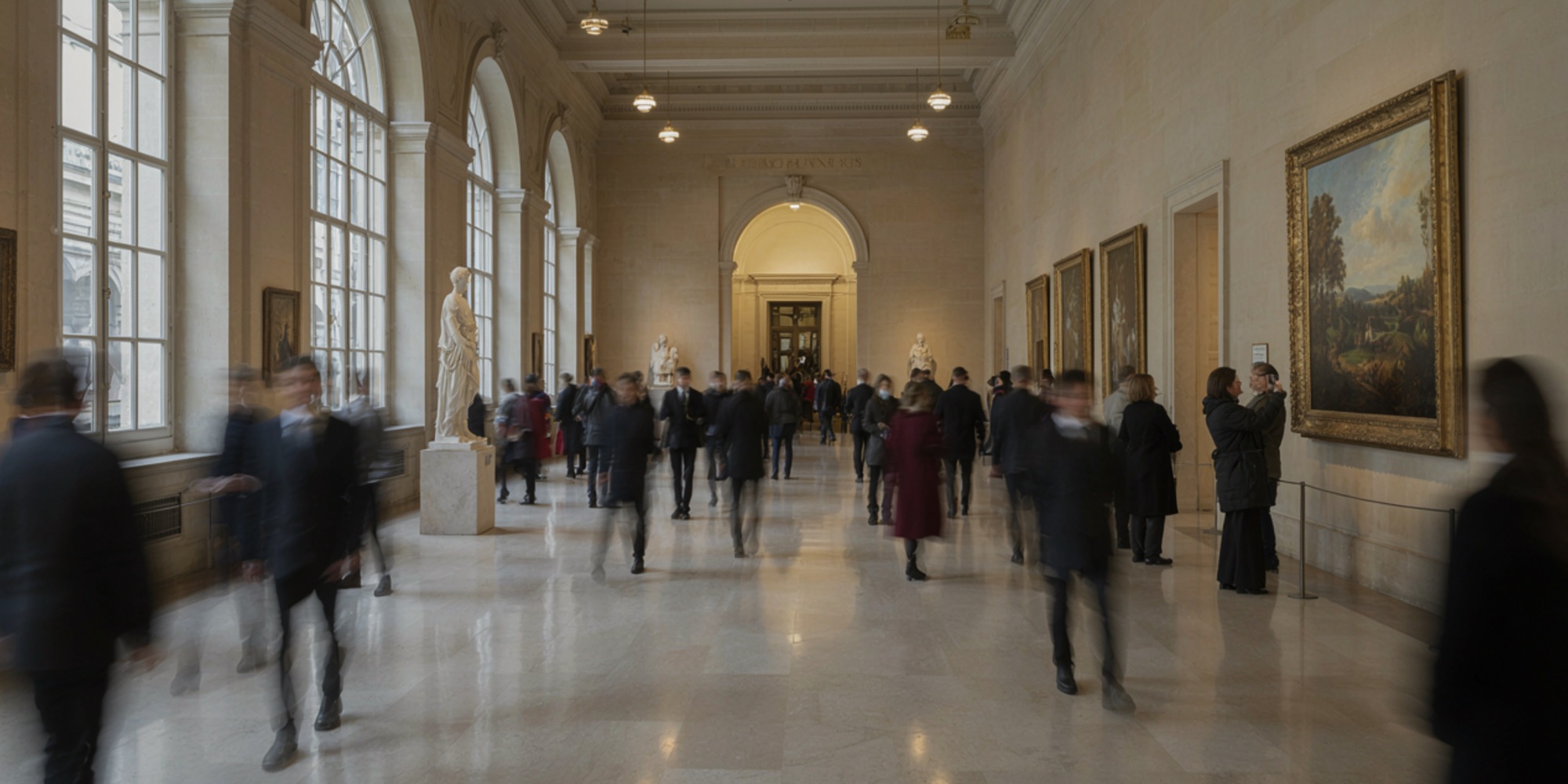
Imagine being able to measure the quality of your visitors’ experiences, track the metrics that matter and see where there is room to improve. By understanding how successfully your venue or location is engaging visitors, you can continuously monitor performance and make informed decisions to enhance the overall experience.
This is the opportunity behind Experience Intelligence, transforming how we understand and measure visitor experiences by turning behavioural insights into actionable intelligence. It gives venues a new way to identify what is working, uncover opportunities for improvement and continuously optimise the visitor journey.
So how can museums, BIDs, city centres and cultural spaces use this data to better understand, personalise and improve visitor experiences?
Visitors are constantly generating valuable signals about their experiences. They show us where they go, what they stop to look at, what they search for, what they skip, where they spend time and how they move through a space. Yet for many physical environments, much of this information remains difficult to capture, connect and understand.
Museums may know how many people entered through the doors. A city centre may know its footfall. A BID may understand how busy an area is at different times of day. A cultural venue may track ticket sales, café revenue, membership numbers or event attendance. These are all valuable measurements, but they only tell part of the story.
Experience Intelligence provides an opportunity to look beyond individual metrics and develop a deeper understanding of the experience itself. It brings together behavioural data, analytics and technology to help organisations understand what visitors are doing, identify opportunities for improvement and create more relevant experiences.
At BAENAV, we are exploring how Experience Intelligence can move beyond individual buildings and indoor environments to understand visitor experiences across entire physical spaces, including museums, galleries, city centres, cultural districts and other visitor destinations. Our pilot phase explores what becomes possible when visitor behaviour, context, and experience come together.
What is Experience Intelligence?
Experience Intelligence is an emerging approach to understanding and improving experiences through a combination of behavioural data, analytics, technology and human insight. In simple terms, it is about creating the ability to sense, understand, respond to and evaluate visitor experiences.
Research into customer and consumer experience intelligence connects advanced analytics and AI with understanding interactions across multiple touchpoints. In physical environments, this concept can extend to information such as movement, dwell time, queues, crowding, navigation and interactions with different parts of a venue.
Rather than looking at one isolated measurement, Experience Intelligence considers the wider visitor journey. For example, instead of simply knowing that 10,000 people visited a museum, an Experience Intelligence approach could help identify which areas attracted the most attention, where visitors spent time, which routes different groups took, where congestion occurred and which attractions or services visitors discovered. This creates a much richer picture of the visitor experience.
The research available today describes Experience Intelligence as a capability that can sense behaviour and context, infer intent and experience quality, orchestrate adaptive responses, and evaluate the resulting impact. That shift, from simply measuring activity to understanding the experience behind it, is where the opportunity lies. (All sources can be found at the bottom of this article)
How is Experience Intelligence currently used in physical spaces?
While the term Experience Intelligence is still developing, many of the technologies and practices behind it are already being used in physical environments.
Retail provides one useful example. Smart retail environments can combine information from footfall counters, cameras, sensors, point-of-sale systems, digital signage and connected technologies to understand what happens between a customer entering and leaving a space. This can reveal patterns such as busy periods, movement between zones, queues, dwell times and areas where customers appear to experience friction.
The same principles can be applied to cultural spaces. A museum can use visitor movement data to understand how people navigate an exhibition. A gallery can examine where visitors spend time. A BID can look at how people move between different parts of a town centre. A cultural district can investigate how visitors move between attractions, hospitality, retail and public spaces.
The technology itself is not the end goal. The value comes from turning data into useful insight.
From footfall analytics to visitor experience intelligence
Footfall is one of the most established measurements for physical spaces. It answers a basic but important question, how many people are there? However, footfall alone cannot explain what those people are experiencing. Two spaces could have the same number of visitors while delivering very different experiences.
One might have visitors who explore multiple areas, spend time engaging with content, discover additional attractions and return in the future. Another might have high footfall but significant congestion, confusing navigation or visitors who leave without discovering much of what the space has to offer.
The number of visitors is the same. The experience is not.
This is why the next stage of visitor analytics needs to look beyond counting people and towards understanding behaviour. Experience Intelligence can bring together different signals from across the visitor journey to create a more complete picture.
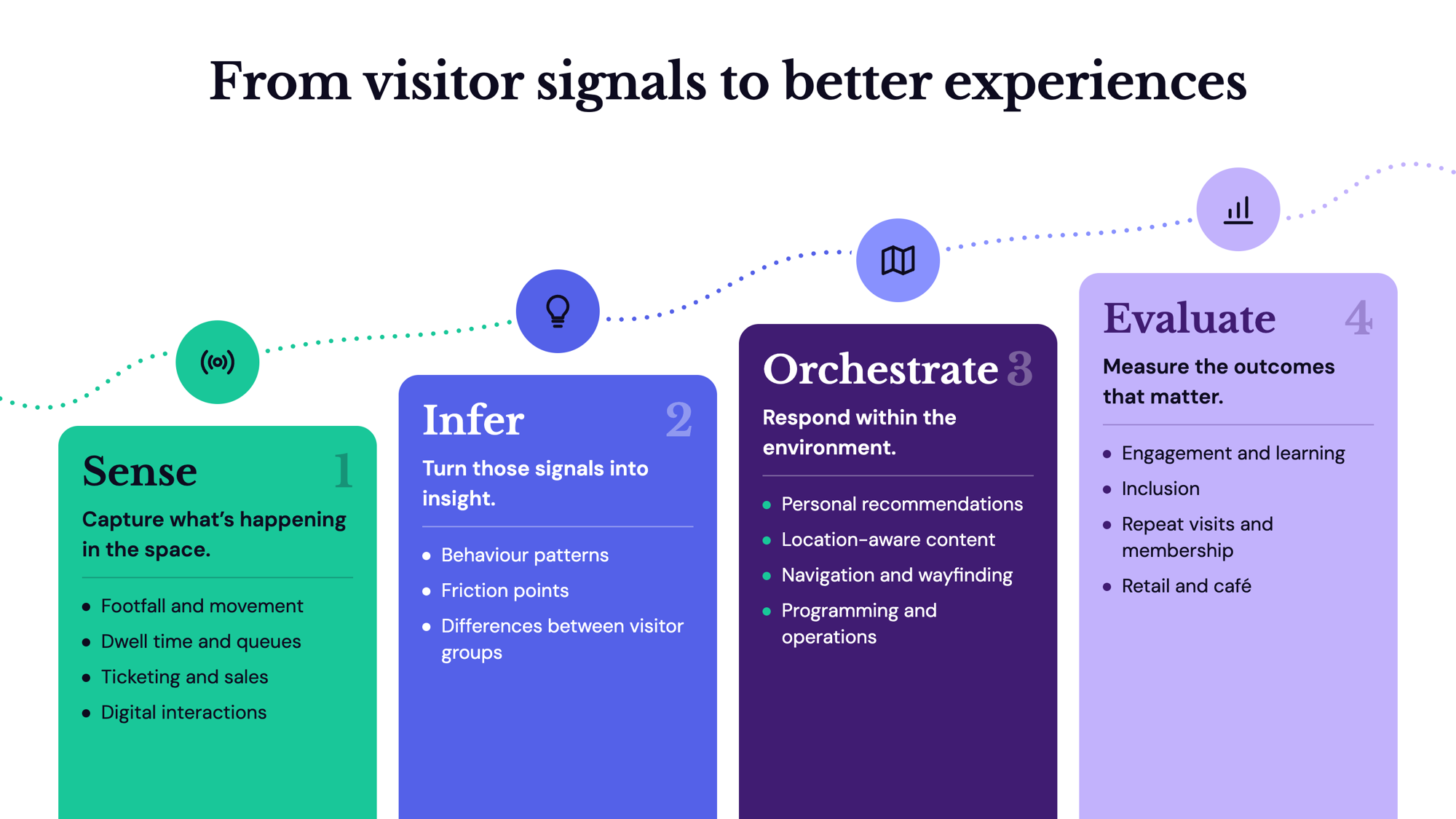
The research currently available proposes four interconnected layers:
1. Sense
The first layer involves capturing relevant information about what is happening in the physical environment. This could include footfall, movement, dwell time, queues, crowding, environmental information, ticketing data, point-of-sale information and digital interactions.
2. Infer
The next stage is turning those signals into meaningful insights. Journey analytics and predictive models can help identify behavioural patterns, potential friction points and differences between visitor groups.
3. Orchestrate
Insights can then inform responses within the environment. These could include personalised recommendations, location-aware content, navigation, digital information, programming or operational adjustments.
4. Evaluate
Finally, organisations can measure the impact of those interventions. Relevant measures could include engagement, learning, inclusion, repeat visits, membership, retail or café activity and other outcomes that matter to the individual organisation.
Together, these layers create a feedback loop rather than a simple reporting system.
Why Experience Intelligence matters for cultural spaces
Museums and cultural venues already collect a considerable amount of information. They may have ticketing data, membership information, event attendance, retail and café sales, visitor surveys, website analytics and footfall measurements. However, the data is often fragmented. The challenge is connecting these different pieces of information to understand the wider visitor journey.
For example, knowing that a museum shop generated a particular amount of revenue is useful. Understanding how many visitors passed the shop, how many entered, where they had previously explored and whether a recommendation influenced their journey can provide additional context.
The same applies to visitor engagement. Instead of simply measuring whether visitors attended an exhibition, Experience Intelligence can help organisations understand the journey around that interaction. This could include how visitors discovered an exhibition, how they navigated towards it, how long they spent there and what they explored afterwards.
This moves the focus from simply reporting what happened towards understanding the patterns behind visitor behaviour.
Personalisation: turning intelligence into better experiences
One of the most exciting opportunities Experience Intelligence creates is personalisation.
Visitors are not all the same. A family visiting a museum for two hours has different needs from a local member making their tenth visit. A tourist interested in architecture may want something very different from a visitor primarily interested in contemporary art. Yet physical spaces have traditionally had to provide a relatively standardised experience. Maps, signs, brochures and recommendations are often designed for a general visitor rather than an individual. Technology creates an opportunity to change this.
Research into AI and cultural tourism increasingly explores personalised recommendations, conversational guidance, behaviour-aware systems, and location-informed experiences. Recent research also identifies potential benefits in engagement, relevance, and accessibility, while highlighting important considerations around privacy, explainability, and visitor autonomy. At BAENAV, we recognise that safeguarding visitor data is essential to building trust and meeting regulatory requirements. Our approach prioritises responsible data handling by implementing privacy-by-design principles, data minimisation, and robust anonymisation methods. We ensure that all data collected is used ethically, only for approved purposes, and that organisations retain transparency and control over visitor information at every stage.
For BAENAV, personalisation is an important part of the Experience Intelligence opportunity. A visitor could receive information that is more relevant to their interests, needs and context. Navigation could reflect what they want to see, while recommendations could help them discover experiences they might otherwise miss.
This does not mean removing the human element from cultural experiences. It means giving venues better information and technology to support the experience they already want to create.
Taking Experience Intelligence beyond the building
This is where BAENAV sees an important opportunity. Much of the existing thinking around intelligent physical environments focuses on individual buildings or controlled indoor environments. Museums, galleries, retail environments and other venues are relatively defined spaces where technologies can be installed and tested. But visitor experiences do not stop at the entrance.
A visitor might arrive in a city centre, walk to a museum, stop for coffee, visit a gallery, explore a public space, attend an event and then visit a restaurant. From the visitor's perspective, this can feel like one connected journey. From an organisational perspective, it may be divided between multiple businesses, attractions, public spaces and systems.
BAENAV wants to explore what happens when Experience Intelligence extends across these boundaries.
This could mean looking beyond an individual museum to understand how visitors move through a cultural district. For a BID, it could mean developing a richer understanding of how visitors navigate a town centre. For a city centre, it could mean connecting information about attractions, streets, public spaces, retail and hospitality to understand the wider visitor journey. It could also mean using location, behaviour and contextual information to understand what happens before visitors arrive at a venue and after they leave.
This represents a move from indoor Experience Intelligence to place-based Experience Intelligence.
Why outdoor spaces are the next frontier
Outdoor environments are more complex than controlled indoor spaces. They have more variables, more stakeholders, and fewer clearly defined boundaries. Weather can influence behaviour. Events can change movement patterns. Public transport affects arrival and departure. Businesses operate at different times. Visitors can move between areas without interacting with any single organisation. Yet these complexities are precisely what make understanding the wider visitor journey valuable.
For a city centre or BID, overall footfall provides an important starting point. Adding information about movement patterns, dwell areas, visitor flows, and interactions with different destinations can create a much richer picture of how people experience a place. This can help identify opportunities in navigation, discovery, visitor engagement, programming, and the connections between different attractions and businesses.
The objective is not simply to collect more information. It is to understand how a place works from the perspective of the people using it.
What could a BAENAV pilot reveal?
This is where the pilot phase becomes particularly important. Experience Intelligence is a developing field, and significant research gaps remain around long-term evaluation, multimodal data, privacy, bias, inclusion, and real-time applications in cultural environments.
Rather than assuming that every answer already exists, BAENAV wants to test what can be learned in real-world environments.
A pilot could help a participating organisation better understand visitor behaviour, identify opportunities to improve the visitor journey, and explore how technology can support more personalised experiences. It could also help identify areas that traditional measurements may not capture. For example, a venue may discover that visitors consistently miss a particular attraction, that certain areas experience congestion at specific times, or that different visitor groups take noticeably different routes through a space. These insights could then inform practical decisions around navigation, information, programming, staffing or visitor engagement.
By acting on these insights, organisations can see tangible benefits such as increased visitor engagement, higher satisfaction scores, and greater secondary spend in shops or cafes. For instance, after identifying and addressing areas of congestion, a venue might see a smoother flow of visitors and improved feedback in post-visit surveys. Similarly, tailoring experiences based on visitor behaviour could lead to longer dwell times and increased revenue per visitor. These kinds of measurable outcomes help justify investment in Experience Intelligence to key stakeholders.
The pilot approach also allows organisations to explore the technology before committing to a larger-scale implementation.
Experience Intelligence creates a continuous feedback loop
The real potential of Experience Intelligence is not simply collecting more information, but how it creates a continuous feedback loop.
A visitor interacts with a space, then those interactions create signals. The signals provide insights which help the organisation understand its visitors. That understanding informs improvements. The improved experience generates new interactions and new insights. And the cycle continues.
This is particularly relevant for organisations that want to become more visitor-centred. Instead of relying solely on occasional surveys or annual reports, venues can begin exploring a more continuous understanding of what is happening within their spaces.
The aim is not to monitor visitors for the sake of monitoring them. It is to understand experiences well enough to make informed decisions about how spaces can work better for the people using them.
What could Experience Intelligence mean for your organisation?
For museums, Experience Intelligence could help connect visitor behaviour with exhibitions, navigation, learning and secondary spend.
For BIDs, it could provide a richer picture of how people move through and experience a town or city centre.
For city centres, it could help explore how attractions, streets, public spaces and businesses contribute to a wider visitor journey.
For cultural districts, it could help connect experiences that currently sit across organisational boundaries.
And for any visitor-facing organisation, it could provide a new way of thinking about the relationship between people, place, technology and experience.
The opportunity is to move beyond measuring how many people visited and towards understanding what visitor behaviour can tell us about the experience itself.
Join the BAENAV Experience Intelligence pilot
The future of visitor experience will not be created by technology alone. It will come from understanding how technology, data and human-centred design can work together to make physical spaces more relevant, accessible and engaging.
That is what BAENAV wants to explore.
We are looking to work with museums, BIDs, city centres and cultural spaces that want to investigate what Experience Intelligence could reveal about their visitors. The pilot phase provides an opportunity to test the technology in a real environment, explore visitor behaviour and identify insights that may not be visible through traditional footfall or revenue measurements alone.
It is also an opportunity to help shape what Experience Intelligence could look like across the UK's physical visitor economy. The future of visitor experience may not simply be about collecting more data. It may be about listening to what visitors are already telling us, and using those insights to create better experiences.
Ready to explore Experience Intelligence in your space?
If your museum, BID, city centre or cultural space wants to understand visitors in a new way, get in touch with BAENAV to discuss joining the pilot phase.
Frequently Asked Questions
What is Experience Intelligence?
Experience Intelligence is the use of data, analytics and technology to understand, improve and personalise experiences. The concept is mostly associated with indoor spaces, and BAENAV is looking to expand the research into more physical spaces, combining information about visitor behaviour, movement, engagement and context to provide a deeper understanding of the visitor journey.
What is Experience Intelligence in museums?
Experience Intelligence in museums involves using behavioural and visitor data to understand how people move through exhibitions and interact with different parts of a venue. It can support areas such as personalised recommendations, navigation, visitor engagement, exhibition planning and operational decision-making.
How is Experience Intelligence different from footfall analytics?
Footfall analytics primarily measure how many people enter or move through a space. Experience Intelligence takes a broader approach by considering behaviour, movement, dwell time, engagement, navigation and other signals to develop a more complete understanding of the visitor experience. Resulting in a more holistic metric of the overall experience a venue provides.
How can Experience Intelligence improve visitor experience?
Imagine finding out that your Experience Intelligence score sits around 60%, then being provided the tools and suggestions to increase that score to 80-90%. Improving satisfaction, value, resources, and the overall success rate of the visitor experience. Experience Intelligence can help organisations identify friction points, understand visitor preferences and make experiences more relevant. Insights can potentially be used to improve navigation, recommendations, content, programming, accessibility and the overall visitor journey.
Can Experience Intelligence be used outside museums?
Yes. The principles of Experience Intelligence can be applied to many physical environments, including galleries, cultural districts, BIDs, shopping areas, city centres, tourist destinations and other visitor-facing spaces.
BAENAV is particularly interested in exploring how Experience Intelligence can extend beyond individual buildings into wider outdoor environments.
What is place-based Experience Intelligence?
Place-based Experience Intelligence extends the principles of Experience Intelligence across a wider physical area rather than focusing on one building.
For example, a BID or city centre could explore visitor movement between attractions, public spaces, hospitality, retail and cultural venues to develop a broader understanding of the visitor journey.
How can Experience Intelligence support personalisation?
Experience Intelligence can use behavioural and contextual insights to help provide more relevant recommendations, information and navigation. Instead of providing every visitor with exactly the same journey, technology can help organisations explore ways of adapting experiences around different visitor needs and interests.
What data can be used for Experience Intelligence?
Depending on the environment and available technology, Experience Intelligence can draw on sources such as footfall data, movement patterns, dwell time, queues, ticketing, point-of-sale data, digital interactions, environmental information, and visitor feedback. Importantly, Experience Intelligence is designed to integrate with the systems and data sources that museums and cultural venues already use, such as ticketing platforms, membership databases, retail and café systems, and visitor surveys. This makes it possible to build on existing infrastructure and combine new behavioural insights with current records, helping organisations transition seamlessly and maximise value from their current data. The appropriate data sources will depend on the organisation, its objectives and the relevant privacy and governance requirements. Implementing BAENAV technology adds another layer of metrics related to individual experiences, ultimately further developing and transforming the data collected within Experience Intelligence.
Does Experience Intelligence use artificial intelligence?
Artificial intelligence can be one component of an Experience Intelligence system. AI and advanced analytics can help identify patterns, make recommendations, predict behaviour and support personalised experiences. However, Experience Intelligence is broader than AI alone and also involves data collection, human insight, physical environments and evaluation.
How can museums measure visitor experience?
Museums can measure visitor experience using a combination of quantitative and qualitative information. Traditional methods include visitor surveys, feedback, attendance, ticketing and footfall data. Experience Intelligence can complement these approaches with behavioural information such as movement, dwell time, navigation and engagement patterns. Many of these measurements can be time-consuming or depend on outdated technologies, therefore, introducing BAENAV can bring together all the information needed into one place!
Why should a cultural space participate in an Experience Intelligence pilot?
A pilot allows a museum, BID, city centre or cultural space to explore the potential of Experience Intelligence in a real-world environment before committing to a wider implementation.
It can help organisations identify new visitor insights, test technology, understand behavioural patterns and explore practical opportunities to improve the visitor experience.
What is BAENAV's Experience Intelligence pilot?
BAENAV's pilot is an opportunity for UK museums, BIDs, city centres and other cultural spaces to explore how Experience Intelligence can be applied to real physical environments.
The aim is to understand visitor behaviour more deeply, explore personalisation and investigate how the approach can extend from indoor venues to wider outdoor spaces and destinations.
Can Experience Intelligence measure outdoor visitor experiences?
BAENAV is exploring how Experience Intelligence can be extended into outdoor environments such as city centres, cultural districts and other visitor destinations.
Outdoor Experience Intelligence could help organisations develop a richer understanding of visitor movement, engagement and behaviour across spaces that extend beyond the boundaries of a single venue.
What is the future of Experience Intelligence?
The future of Experience Intelligence is likely to involve increasingly connected data, spatial technologies and personalised experiences across physical environments. For cultural spaces, this could create new opportunities to understand visitors and continuously improve how people experience museums, city centres, attractions and destinations.
Sources
The article draws particularly on the frameworks and physical-space research supplied in your reference document.
- Consumer Experience Intelligence (CEI) Framework: JETIR research paper
- AI and Customer Experience literature review: Springer research article
- AI and cultural tourism / visitor experience research: Bournemouth University research
- Spatially Intelligent Arts Centre / Human–Building Interaction: SAGE research article
- Artificial intelligence and museum experiential transformation: Smart Learning Environments
- Museums and AI Network toolkit: AI: A Museum Planning Toolkit
- Human–Building Interaction and lived experience: Frontiers in Computer Science research